The Entangled Neighbours: What a Democratic Sweep Means for Canada and What It Doesn't
The 2025 Canadian Election Study shows which Canadian expectations the new signal can move, and which it cannot.
American elections rarely remain exclusively American. Changes in Washington travel across borders through trade, diplomacy, security arrangements, and political relationships, shaping how neighboring countries understand their own interests. For Canada, whose economic and political relationship with the United States is deeply intertwined with its domestic affairs, a shift in American political power carries consequences beyond the ballot box.
The Quantum Politics Institute (QPI) approaches elections as observations of an evolving system of political power rather than isolated events. The central question is not simply who wins, but how that change reverberates through international relationships and the political expectations of America's partners. Canada's experience offers an important case study.
Using the 2025 Canadian Election Study (CES), conducted between March 24 and April 28, 2025 (Stephenson et al., 2025), this analysis examines the political attitudes Canadians brought into the 2026 U.S. midterm period. The distinction is essential: the survey predates the midterms and does not measure reactions to their outcome. Instead, it establishes the political baseline against which the consequences of a Democratic sweep can be examined.
A shared consensus
Before the midterms, Canadians had developed a remarkably consistent assessment of their relationship with the United States. Nearly nine in ten respondents (89.9%) believed bilateral relations had deteriorated, while 84.8% attributed responsibility to the United States. Only 3.3% blamed Canada (Figure 1).
Figure 1
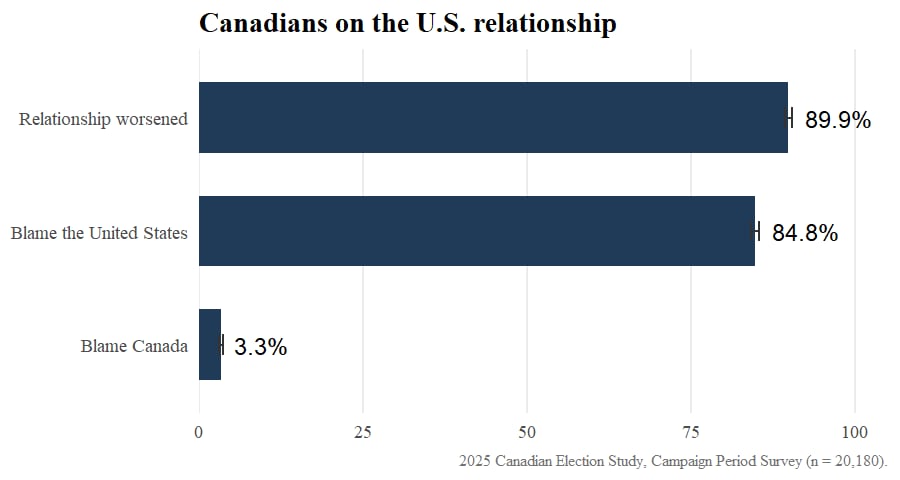
This is more than widespread dissatisfaction; it represents a broad convergence in how Canadians understood the deterioration of the relationship. Yet, beneath this national consensus lies a more revealing divide: Canadians disagree considerably on how responsibility should be assigned.
Who will welcome America's "blue sweep"?
A Democratic sweep of American political institutions will not necessarily generate a uniform response north of the border. The 2025 Canadian Election Study suggests that Canadians' interpretations of American political developments are strongly differentiated by their domestic political affiliations. The question, therefore, is not simply whether Canadians will welcome a shift in American political power, but which segments of the Canadian electorate are more likely to view that shift favorably.
The partisan differences are striking. Among Canadians who identify with the Liberal Party, 95.8% attribute responsibility for the prevailing tensions to the United States (95.1–96.4). The proportion falls to 68.4% among Conservative identifiers (66.7–70.1), and to just 38.9% among People's Party identifiers (30.3–47.6) (Figure 2a).
Figure 2a
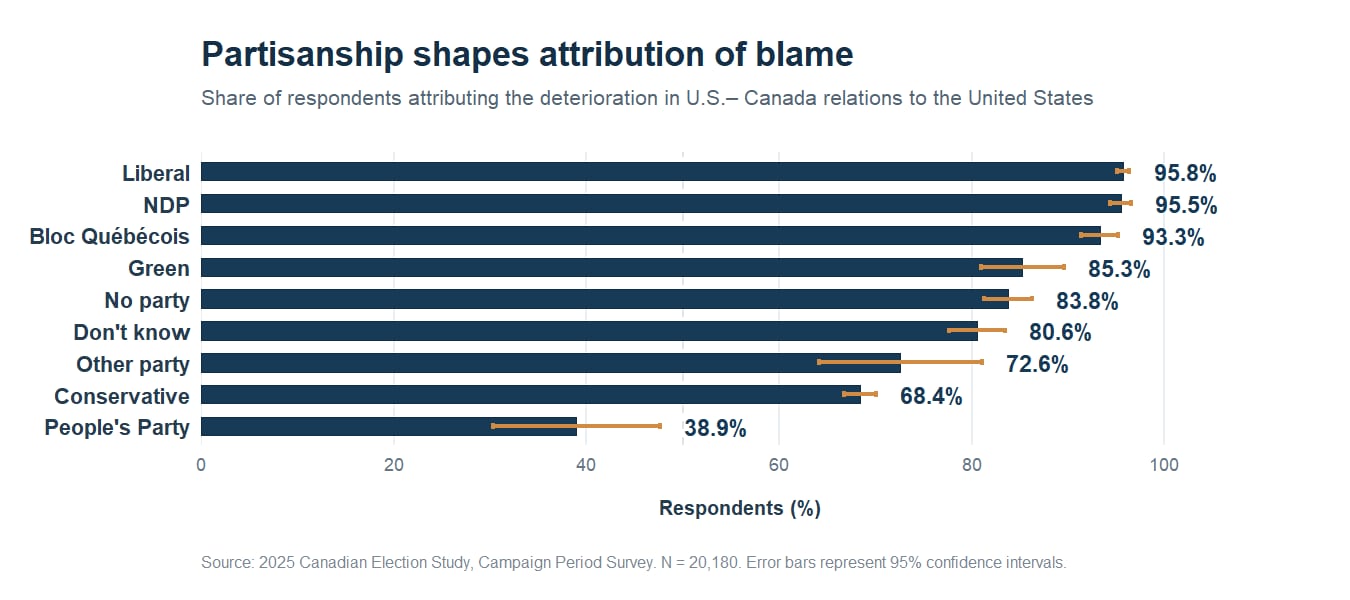
These differences offer an important clue to how a Democratic consolidation in Washington may be received in Canada. Liberal identifiers may be more receptive to a change in American leadership, particularly if they associate recent bilateral tensions with Republican political decisions. Conservative identifiers may approach the transition with greater reservations, while People's Party identifiers appear considerably less inclined to attribute responsibility to the United States.
Geography tells a different story. Attribution ranged from 87.9% in Atlantic Canada to 81.6% in Western Canada, a spread of just 6.3 percentage points. The 27.4-point difference between Liberal and Conservative identifiers is more than four times as large (Figure 2b).
Figure 2b
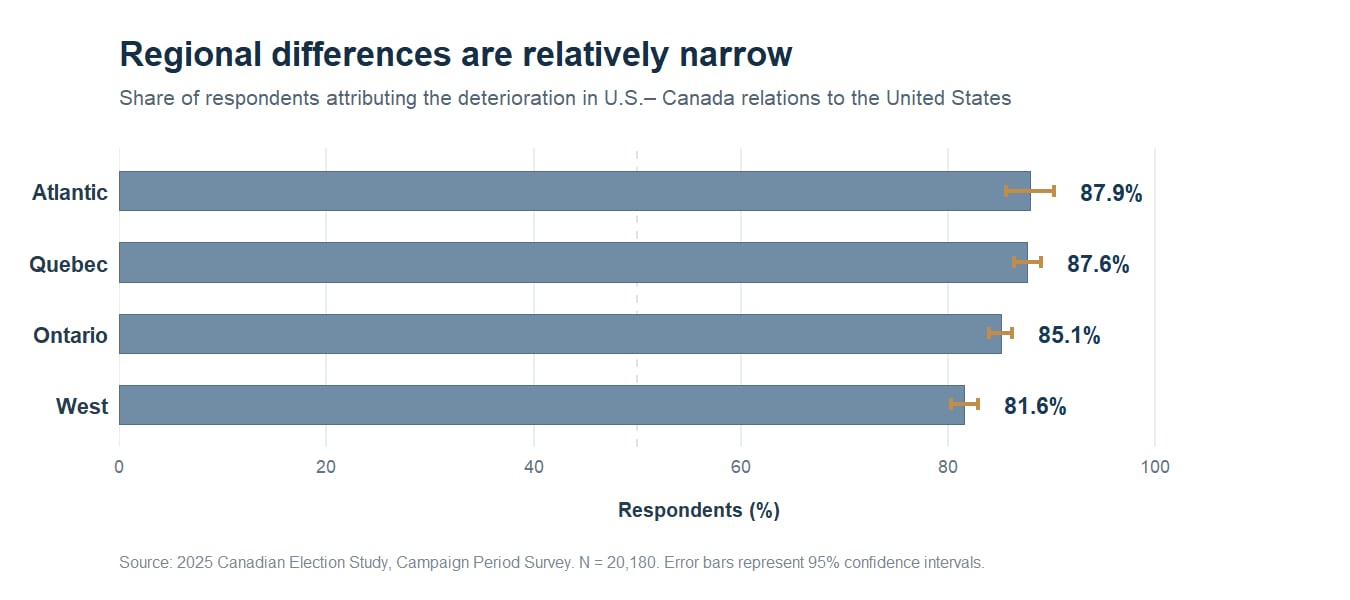
The distinction is significant. Canadian interpretations of American political change appear to be shaped more strongly by domestic political identity than by regional location. A blue sweep may therefore generate different political reactions across Canada's electorate, even when Canadians share broadly similar concerns about the bilateral relationship.
Beyond blame: The economy and security
The same divide appears beyond blame. Party shaped Canadians' opinions on the economy and security in 2025.
The economy
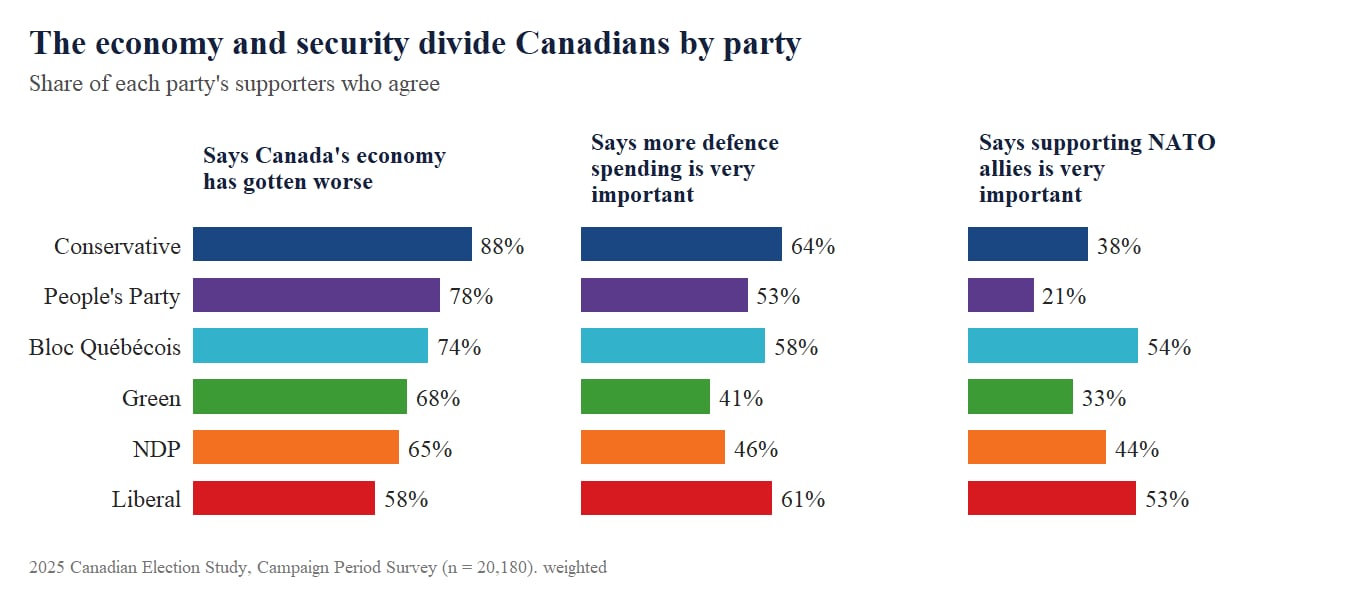
58% of Liberal identifiers say Canada’s economy has worsened, compared with 88% of Conservative identifiers and 78% of People’s Party identifiers as shown in Figure 3.
This measure looks backward: it captures how Canadians judged the economy before the midterms, not what they expect from a Democratic Congress. That makes it a baseline. A change in Washington’s trade posture will reach a public whose economic mood is already divided by party.
Security
The parties also disagree on what security means. Conservative identifiers are the most likely to call defense spending very important (64%, against 61% of Liberals and 41% of Greens), yet they are less likely than Liberals to say the same of NATO (38% against 53%). People’s Party identifiers sit furthest from the alliance, at 21% (Figure 3).
Figure 3
Conclusion
Canadians entered the midterm period with a shared diagnosis: the relationship between the US and Canada has soured, and the United States is mostly to blame. What they do not share is the interpretation. Party shapes how Canadians read the economy, security and the bilateral relationship.
A Democratic sweep will therefore meet a public that is unlikely to shift in aggregate, since the diagnosis is already saturated, and likely to divide along lines set before the midterms. Canadians will respond less to what Washington does than to how their own party teaches them to read it.
Related reading
A Nation in Superposition: America's Political Future at the Crossroads
Politics is rarely determined by a single election. It is the product of interconnected forces, competing interests, institutional structures, and...
Discussion 0